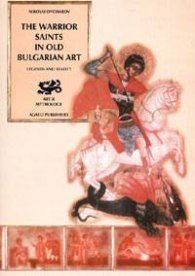
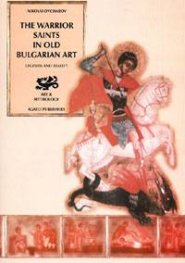
The Warrior Saints in Old Bulgarian Art
Автор: Nikolai Ovcharov
| Издател | Агато |
| Брой страници | 114 |
| Година на издаване | 2003 |
| Корици | меки |
| Език | английски |
| Тегло | 240 грама |
| ISBN | 9548761394 |
| Баркод | 9548761394 |
| Категории | Изкуство, Книги |
A saint and a warrior are completely incompatible notions in the frames of initial Christian beliefs. It is Christian religion that preaches: "Resist not evil: but whosoever shall smite thee on thy right cheek, turn to him the other also. " (Matt. 5:39) Moreover, it was naked and defenceless Christians who were thrown in lion cages for the amusement of Roman spectators. Humble and lenient as it was, their prayer to God was the one and only support they had. In their prayers they would ask mercy to come even upon their tormentors who had no other fault but being incapable of having deeper insight into the future. Violence was completely alien to that religion. Its devoted followers gathered in deep caves, for they were chased and severely tortured by the-old-religion adherents.
Then years passed by. And the time of reversal finally came. Despite the persecution against them. Christians became powerful enough as to be able to hold resistance to the Roman authorities. Gradually, they set up the foundations of a mighty organisation against the pagan authorities, and it penetrated all structures of the state. The major effect of emperor Diocletian's (284-305) sweeping repressions was that they brought about the consolidation of the new religion. Thus, the whole process came to its logical conclusion.
In the battle against Maxentius, A.D. 312, Emperor Constantine saw a huge shining Cross rising high up in the sky. Christian religion finally had its triumphant star on the ascendant. An autocrat and reformer alike, this Emperor introduced a crucial change in the religion of his subjects. In historical terms, however, this means a cruc;al change of everything. Even the place of the Roman Empire capital city was changed: on the Bosporus it was the magnificent Constantinople that came up, in all of its splendour, with gorgeous churches and palaces. For not more than a few years, Christianity was turned from a persecuted heresy into a dominating state religion.
Strange as it may seem, it was not before the final triumph that Christianity encountered its most essential controversies. As long as it opposed the previously established religion, it preserved its purity built up on the bases of major human virtues. Access to power quickly brought about corruption. Gifts poured over from all sides upon the churches which had already become much too rich; alongside, there came the decay of Christian morality which, in past years, had captivated the minds of millions of suffering people.
The new oracles of the powerful church institutions, such as popes, patriarchs and bishops, had all too little in common with the previous rigorists and martyrs for Christian ideas. Not only did they not take the faith to their hearts. Moreover, they were yet another example in human history of the impossibility for high ideals to be sustained in daily human life.
Hence, there appeared a strong demand for creating symbolic images. Both intricate and comprehensive, symbolic notions were largely used as a specific substitute for reality. This trend was particularly evident in Byzantium and the world of Eastern Christianity. Current researchers often reach the conclusion that communicating the world in terms of symbolic notions practically displaced realistic approaches to life. The Byzantines would appear to have had created a visionary world of their own existing alongside with the real one. This refers to all aspects of their life, ranging from daily life of common folks to the highly sophisticated symbolic ceremonies performed by the Emperor nearly every hour of the day.
To be sure, the use of symbols found its most vigorous display in church practice. The famous Byzantine philosopher from the Seventh Century, Pseudo-Dionysius the Areopagite, distinguishes between three types of symbols. The first group comprises the semiotic patterns which were understood only by a restricted number of specially initiated people. The second group bears upon the first one and it includes liturgic symbolism wherein every symbol stands for its own, strictly specific meaning. These two groups of symbols are the so-called "unresembling resemblances". Their meaning is deeply esoteric.
Nikolai Ovcharov
Все още няма мнения за тази книга.
Напиши коментарЩе бъдат допускани само мнения свързани с конкретния продукт или автор.
Ще бъдат изтривани мнения:
- Съдържащи обидно или нецензурно съдържание
- Написани само с главни букви
- Написани на латиница
- Съдържащи препратки към други сайтове.
Други въпроси и мнения моля, изпращайте на [email protected]